Case study
Crowd-sourced accessibility review platform
Built Access A11Y, a crowd-sourced accessibility review platform covering Washington DC and New York City for the Equal Rights Center.
Industry
Government & Civic / Disability Rights
Key result
Full
Platform built
Services
The Challenge
The Challenge
For most people, choosing a restaurant or running an errand is simple. For people with disabilities it is not. A step at the entrance. A restroom that is technically accessible but barely usable. A parking lot with no accessible spaces left. These are not inconveniences — they are barriers that determine whether someone can participate in public life. The problem was not only the barriers themselves but the uncertainty around them: there was no reliable way to know ahead of time whether a place was actually accessible.
The available workarounds were poor. Calling ahead meant hoping someone answered and actually knew the answer. Showing up and discovering the place was inaccessible meant a wasted trip, potential embarrassment, and real frustration. Yelp had an "accessible" checkbox, but a checkbox does not tell you whether there is a step at the entrance, whether the accessible restroom is on a different floor, or whether the ramp is steep enough to be a hazard. Community members knew what mattered. They had no shared place to record and share that knowledge.
The Equal Rights Center — a civil rights organization working to eliminate discriminatory barriers in Washington DC and New York — saw the opportunity in that gap. If the disability community could pool what it already knew about real-world accessibility, that knowledge would become a resource no general platform could match. The organization had no digital tool to serve the community directly, and every outing still carried uncertainty that non-disabled people never face. The ERC came to NetAesthetics to build the platform that would make the pooling possible.
The Solution
The Solution
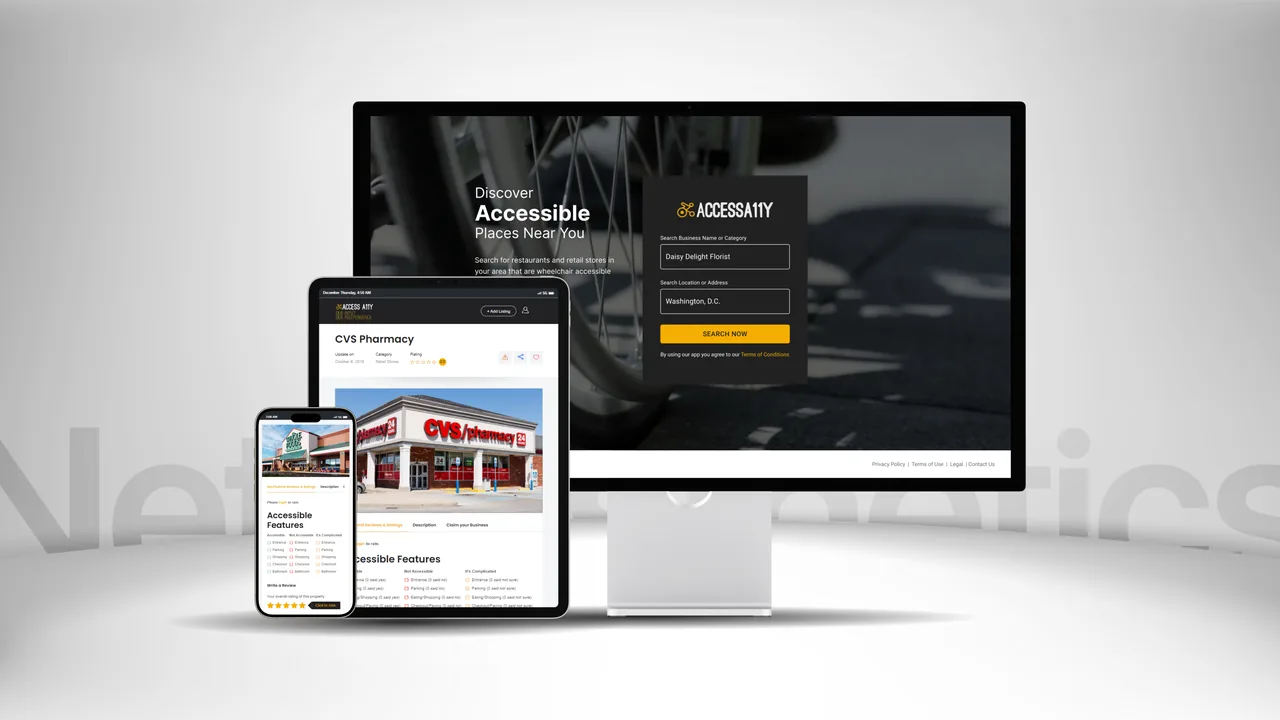
NetAesthetics built the full platform from the ground up on WordPress, using a custom architecture that supports two core actions: searching and contributing. Users search by location and facility type — restaurant, medical office, retail, transit, government building — and browse results with accessibility detail. Each listing shows what the community has reported: entrance accessibility, parking, restroom access, elevator presence, and more. Coverage was built for DC and NYC from launch, on an architecture designed to expand to additional cities without requiring a rebuild.
Any registered user can add a listing that does not yet exist in the database, and any user can leave a structured accessibility review. The review format guides contributors through the specific information that matters — not just whether a place was accessible, but exactly which features were present or absent. Crowd-sourced data introduces problems curated data does not, so duplicate detection was built into the submission flow: a user adding a location that already exists is redirected to the existing listing. Structured fields rather than open text reduce noise.
Google Analytics was integrated from day one, giving the Equal Rights Center visibility into how the community was using the platform — which searches were most common, which cities were most active, and where data gaps existed. The stack — JavaScript, PHP, Bootstrap, jQuery, WordPress, and Amazon Web Services — was chosen for reliability and long-term maintainability. Modernizr was included to handle progressive enhancement across older assistive technology browsers, which the disability community disproportionately relies on.
The Equal Rights Center uses Access A11Y as both a community service and an advocacy tool. What members contribute gives the organization a real-time picture of where accessibility gaps are concentrated — which neighborhoods, which business categories, which types of barriers appear most frequently — and that data supports its legal and policy work. The platform also demonstrates how organized the community's knowledge becomes when given the right infrastructure, shifting the question from whether a place needs investigating to what the community has already recorded.
Results
Results
Full
Platform built and launched end-to-end by NetAesthetics
2
Cities covered at launch — Washington DC and New York City
100%
Community-driven — listings and reviews from real users
A11Y
Accessibility-first design for assistive technology browsers
ERC
HUD-adjacent mission — disability rights and fair access
WordPress + AWS
Built and hosted on
Before & after
Before and after
Before
No centralized resource for accessibility information
Crowd-sourced review platform live and in use
Call ahead, or show up and hope
Search by location and facility type across DC and NYC
Yelp's accessibility filters shallow and unreliable
Community adds listings and writes accessibility reviews
No crowd-sourced, disability-specific reviews anywhere
Granular accessibility data beyond general platforms
ERC had no digital tool serving the community directly
ERC has a mission-driven digital product at scale
Uncertainty on every outing
Outings planned with confidence
Common questions
Common questions
More case studies
Get started
Ready to see what AI
can do for your business?
Book a free 30-minute strategy call. No sales pitch — just honest answers about where AI fits.